
How Much Weight Can a Metal Display Rack Hold? A Buyer's Guide to Load Capacity
When buying custom metal display racks, one of the most important questions is: How much weight can the rack hold? The answer depends on the material thickness, rack structure, shelf design, welding strength, base stability, surface treatment, and how the products are placed on the rack.
For overseas buyers, load capacity is not only a technical detail. It directly affects store safety, product presentation, customer experience, shipping cost, and long-term durability. A display rack that looks good but cannot safely carry the required product weight may bend, shake, deform, or even tip over in retail use.
Why load capacity matters for retail display racks
Metal display racks are used to hold real products in real stores. These products may be light items such as snacks, cosmetics, and accessories, or heavy products such as tools, tiles, hardware, bottled drinks, paint cans, automotive parts, and building materials.
If the rack is underdesigned, it may create several problems:
- Shelves may bend under product weight.
- The frame may shake when customers take products.
- The rack may become unstable when loaded unevenly.
- Welded joints may crack after long-term use.
- Powder coating may be damaged if metal parts rub or deform.
- The display may look cheap or unsafe in the store.
A reliable metal display rack should balance strength, appearance, cost, and shipping efficiency. The goal is not always to use the thickest steel, but to design the correct structure for the real loading requirement.
1. There is no single weight limit for all metal display racks
Different display racks have different load capacities. A countertop wire display for small products may hold only a light load, while a heavy-duty floor-standing rack for tools or tiles may need to carry much more weight.
Load capacity depends on the full design, not only one material number. Two racks made with the same steel thickness may have different strength if the shelf size, support points, welding method, base width, and frame structure are different.
This is why buyers should avoid asking only for a general answer like "How many kilograms can this rack hold?" A better question is: "Can this rack safely hold my products in this quantity and layout?"
2. Product weight is the starting point
Before designing or buying a display rack, buyers should calculate the total product weight per shelf and the total product weight for the whole rack. This information helps the factory choose the right steel thickness, shelf support, base size, and reinforcement structure.
For example, a rack that displays light packaged snacks has a very different load requirement from a rack that displays metal tools or ceramic tiles. Even if the two racks have a similar size, the structure should not be the same.
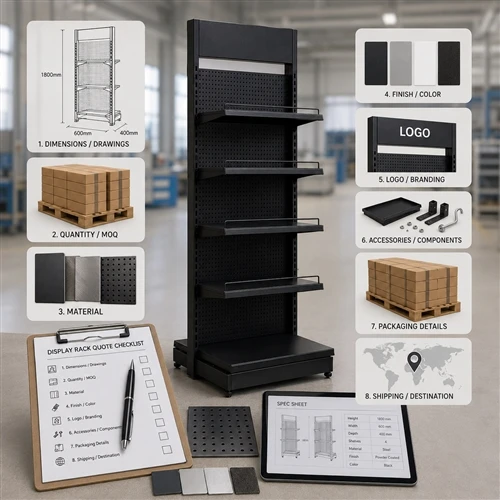
When requesting a quotation, provide these details:
- Single product weight
- Number of products per shelf
- Total weight per shelf
- Total weight for the full rack
- Whether products are placed evenly or concentrated in one area
- Whether customers will frequently remove and replace products
3. Steel thickness affects strength and cost
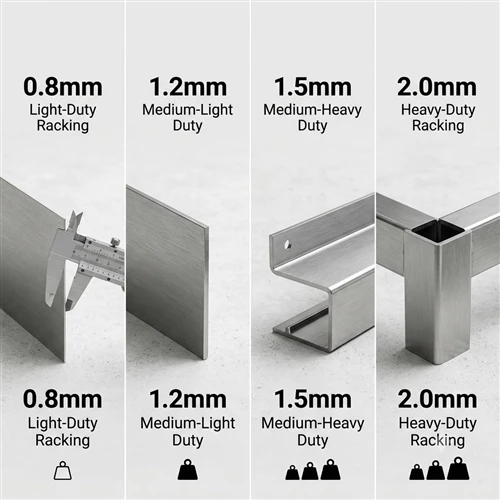
Steel thickness is one of the most important factors in load capacity. Thicker steel can usually provide better strength, but it also increases material cost, product weight, and shipping cost.
For light retail displays, thinner steel may be enough if the structure is well designed. For heavy-duty display racks, thicker tubes, stronger shelves, reinforced brackets, and wider bases may be necessary.
However, thicker steel is not always the best answer. A smart structure can sometimes improve load capacity more effectively than simply increasing material thickness. For example, adding support ribs, back braces, side frames, or shelf brackets may improve strength while controlling cost.
4. Rack structure is more important than material alone
A metal display rack works as a full structure. The frame, shelves, base, brackets, hooks, panels, and connection points all affect how much weight the rack can safely hold.
Important structural factors include:
- Frame tube size and wall thickness
- Shelf width and depth
- Distance between shelf supports
- Back panel strength
- Side frame support
- Base size and weight distribution
- Welding position and connection method
- Whether the rack is assembled or knock-down
A wider shelf without enough support may bend even if the material looks strong. A tall rack with a narrow base may become unstable when products are loaded on the upper shelves. A rack with poor connection points may loosen after repeated use.
5. Shelf design directly affects load capacity
Shelves are the main loading area of most metal display racks. Their design has a major impact on weight capacity and durability.
Common shelf types include:
- Sheet metal shelves
- Wire shelves
- Perforated metal shelves
- Angled shelves
- Adjustable shelves
- Wood or MDF shelves with metal frames
Sheet metal shelves can provide a flat and clean display surface, but they may need folded edges or support ribs for heavier products. Wire shelves are often lighter and allow visibility, but wire diameter and spacing must match the product weight and size. Adjustable shelves are flexible, but the brackets and upright posts must be strong enough for the required load.
6. Welding strength and connection points matter
For welded metal display racks, the quality of welding affects long-term load capacity. Weak or incomplete welding can lead to cracks, shaking, or failure after repeated use.
Important welding details include:
- Weld length and position
- Weld penetration and consistency
- Frame squareness after welding
- Grinding and surface treatment after welding
- Reinforcement at high-stress points
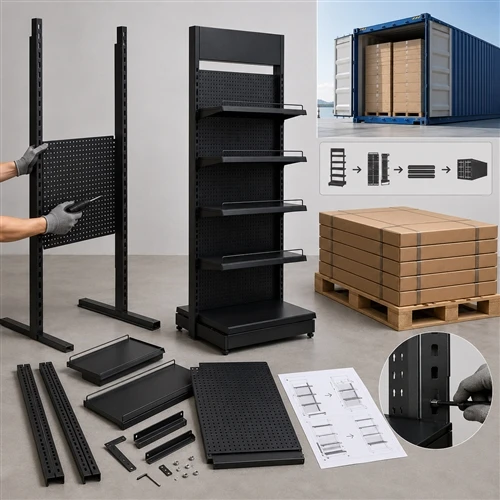
For knock-down metal display racks, bolts, screws, slots, hooks, and connectors also affect strength. A KD structure can save shipping volume, but it must be designed with stable connection points so the rack remains strong after assembly.
7. Base stability is critical for floor-standing racks
For floor-standing display racks, load capacity is not only about shelf strength. The base must keep the rack stable when products are loaded and when customers interact with the display.
A tall rack with heavy products on upper shelves may need a wider base, stronger feet, back support, or an anti-tip design. If the rack has wheels, the casters must match the total load and should include locking functions when needed.
Buyers should tell the supplier where the rack will be used. A rack placed against a wall may have different stability requirements from a freestanding island display in the middle of a store aisle.
8. Hooks, pegboards, and hanging displays need special checks
For pegboard display stands, slatwall display racks, and hook displays, load capacity depends on the panel strength, hole spacing, hook material, hook length, and the way products hang from the rack.
Long hooks can create more leverage, especially when heavy products are placed near the front of the hook. If the pegboard or back panel is too thin, it may deform around the hole area. If the hook wire diameter is too small, the hook may bend.
For hanging products, buyers should confirm:
- Weight per hook
- Number of hooks per panel
- Total hanging weight
- Hook length and wire diameter
- Panel thickness and hole design
- Whether products are loaded evenly
9. Uneven loading can reduce real-world safety
In real stores, products are not always placed evenly. Customers may remove items from one side, staff may restock only part of the rack, or heavier products may be placed on upper shelves by mistake.
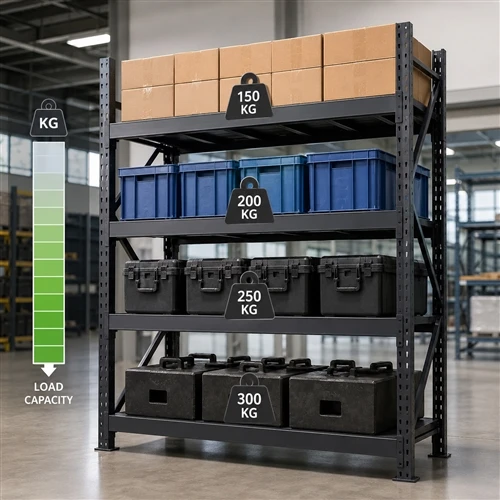
This means a display rack should have a safety margin. It should not be designed to work only under perfect laboratory conditions. A good factory will consider real retail use, including uneven loading, repeated handling, and long-term store operation.
For heavy products, it is usually better to place heavier items on lower shelves and lighter items on upper shelves. This improves stability and reduces tipping risk.
10. Surface finish does not replace structural strength
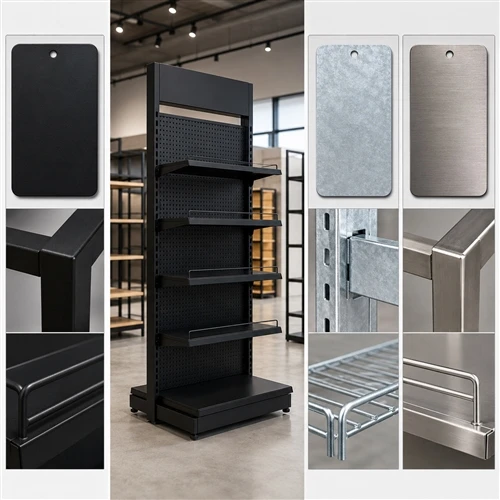
Powder coating, plating, or galvanizing can improve appearance and corrosion resistance, but surface finish does not replace structural strength. A beautifully coated rack can still bend if the material or structure is not suitable for the load.
However, good surface treatment is still important. If a rack deforms under load, the coating may crack or become scratched at stress points. This can affect both appearance and rust resistance.
For humid environments, outdoor use, or heavy-duty applications, buyers should discuss both structure and surface protection with the supplier.
11. How factories test metal display rack load capacity
For custom projects, buyers can ask the factory to test the sample before mass production. Load testing helps confirm whether the rack can safely hold the required product weight.
Common load testing methods include:
- Placing test weights on each shelf
- Testing total rack load
- Checking shelf bending after loading
- Testing hook load for pegboard displays
- Checking rack stability after full loading
- Testing assembly strength for KD structures
Buyers can request photos or videos of the test. For important bulk orders, the approved sample and test result should become part of the production standard.
12. How to choose the right load capacity for your project
The right load capacity should match your product weight, store environment, display method, and budget. Overbuilding the rack may increase cost and shipping weight. Underbuilding the rack may create quality and safety risks.
To choose the right load capacity, ask these questions:
- What products will be displayed?
- How much does each product weigh?
- How many products will be displayed per shelf or hook?
- Will the rack be freestanding, wall-side, or countertop?
- Will customers frequently touch or move the products?
- Is the rack used for light retail goods or heavy-duty products?
- Does the rack need wheels or adjustable shelves?
- Will the rack be shipped assembled or knock-down?
13. Common mistakes buyers should avoid
Many display rack quality problems come from unclear loading requirements. Buyers should avoid these common mistakes before approving a design:
- Only sending rack size without product weight.
- Choosing the lowest price without checking steel thickness.
- Ignoring shelf support and base stability.
- Using long hooks for heavy products without testing.
- Approving a sample without loading products on it.
- Putting heavy products on upper shelves without checking stability.
- Assuming all metal display racks have the same strength.
Metal display rack load capacity checklist
Before placing a bulk order, use this checklist:
- Confirm the weight of each product.
- Confirm the number of products per shelf or hook.
- Calculate total load per shelf and total load per rack.
- Confirm steel thickness, tube size, and shelf structure.
- Check whether the base is wide and stable enough.
- Confirm welding strength and connection points.
- Ask for sample load testing if products are heavy.
- Check whether KD assembly affects strength.
- Confirm packaging protects the rack from deformation.
- Keep the approved load capacity in writing before bulk production.
How Nine Roc Display helps buyers design safe load capacity
Nine Roc Display helps overseas buyers design custom metal display racks based on real product weight, store usage, rack size, shelf layout, and shipping requirements. Our team can recommend suitable steel thickness, frame structure, shelf support, base design, hooks, and surface finish for different retail display projects.
Whether you need pegboard display stands, wire display racks, floor-standing racks, gondola shelving, tile display racks, hardware display racks, or custom POP metal displays, we can help evaluate load capacity before sample and bulk production.
If your products are heavy or require special display conditions, send us your product size, product weight, target quantity, store layout, and reference images. Our engineering team can help create a practical structure that balances strength, cost, appearance, and shipping efficiency.
FAQ
How much weight can a metal display rack hold?
The load capacity depends on the material thickness, rack structure, shelf design, welding strength, base stability, and product layout. A light retail rack and a heavy-duty rack can have very different weight limits.
Is thicker steel always better for display racks?
Not always. Thicker steel can improve strength, but it also increases cost and shipping weight. A well-designed structure with proper support can often provide better value than simply using thicker material.
What information should I provide for load capacity design?
You should provide product size, product weight, quantity per shelf or hook, total rack load, store environment, display method, and whether the rack will be assembled or knock-down.
Can a KD metal display rack still be strong?
Yes. A KD metal display rack can be strong if the connection points, bolts, brackets, and frame structure are designed correctly. Sample assembly and load testing are recommended for heavier products.
Why do shelves bend on some display racks?
Shelves may bend if the material is too thin, the shelf span is too wide, support points are not enough, or the product weight is higher than the design capacity.
Should I test the sample before placing a bulk order?
Yes. For heavy products or important retail projects, sample load testing helps confirm shelf strength, rack stability, hook performance, and overall structure before mass production.
Talk to the Nine Roc Display Engineering Team
WhatsApp / Phone: +86 13688842636
Email: display@nineroc.com
See our custom solutions: www.ninerocdisplay.com

Your Direct Source Factory for Custom Metal Display Racks
Stop overpaying middlemen. Partner directly with Nine Roc Display for your retail fixtures. Whether you need custom pegboards, heavy-duty gondola shelving, or wire racks, our engineering team providesFREE 3D designsand fast prototyping. Send us your ideas today, and let's bring your retail vision to life with premium quality and factory-direct pricing.