
How to Design KD Metal Display Racks for Lower Ocean Freight and Easier Assembly
For overseas buyers, ocean freight is often one of the biggest hidden costs in custom metal display rack projects. A display rack may have a reasonable factory price, but if it is shipped fully assembled, the packing volume can be very large. This increases container space, shipping cost, warehouse handling cost, and sometimes even damage risk.
One practical solution is KD design. KD means knock-down, also called flat-pack or disassembled structure. A well-designed KD metal display rack can reduce shipping volume, improve container loading efficiency, protect parts during transportation, and make store assembly easier. However, KD design must be planned carefully so the rack remains strong, stable, and simple to install after delivery.
What is a KD metal display rack?
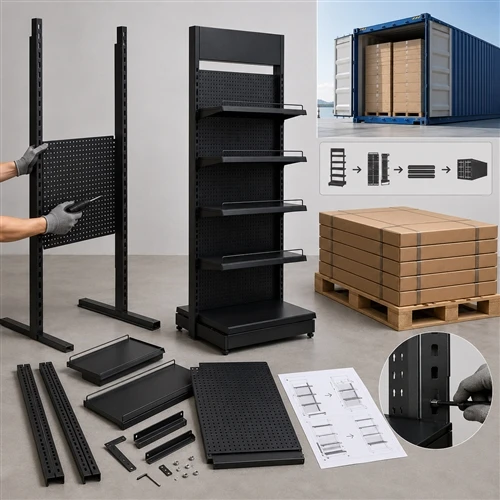
A KD metal display rack is a display rack designed to be shipped in separated parts and assembled after arrival. Instead of shipping the rack as one bulky finished unit, the factory separates the frame, shelves, panels, hooks, base, header card, wheels, and accessories into a compact carton or pallet packing plan.
After the buyer receives the goods, the rack can be assembled by store staff, warehouse workers, installers, or distributors using screws, bolts, slots, brackets, hooks, or tool-free connectors.
KD design is commonly used for floor-standing display racks, pegboard display stands, wire display racks, gondola shelving, slatwall display fixtures, tool display racks, tile display racks, and custom POP metal displays.
Why overseas buyers choose KD display rack design
For international orders, shipping volume can sometimes matter as much as product weight. Metal display racks are often large but not always very heavy. If the racks are shipped fully assembled, they may waste container space because the inside of each rack cannot be used efficiently.
KD design helps solve this problem by making the structure more compact for export shipping. It can also make handling easier in warehouses and stores.
Main benefits include:
- Lower ocean freight cost through smaller packing volume
- Better container loading efficiency
- Reduced risk of frame bending during transportation
- Easier warehouse storage before store rollout
- Flexible distribution to different stores or dealers
- Easier replacement of damaged parts
- Better packing protection for powder coated surfaces
1. Start with the final store use, not only the carton size
A good KD display rack should not be designed only to make the carton smaller. It must also work well in the store. Before deciding the KD structure, buyers should confirm how the rack will be used, assembled, loaded, moved, and maintained.
Important questions include:
- Will the rack be assembled by professional installers or store staff?
- Does the rack need tools for assembly?
- How many minutes should assembly take?
- Will the rack be moved often after assembly?
- What products will be displayed on the rack?
- How much weight should each shelf or hook hold?
- Will the rack be used in one store or distributed to many stores?
If the rack is for a large retail rollout, assembly speed and clarity become very important. A design that saves freight but creates confusion in stores may increase labor cost and complaints.
2. Break the rack into logical parts
The first step in KD design is deciding how the display rack should be separated. The goal is to reduce volume while keeping the structure easy to understand and strong after assembly.
Common KD parts include:
- Left and right side frames
- Back panel or pegboard panel
- Base frame or bottom shelf
- Metal shelves
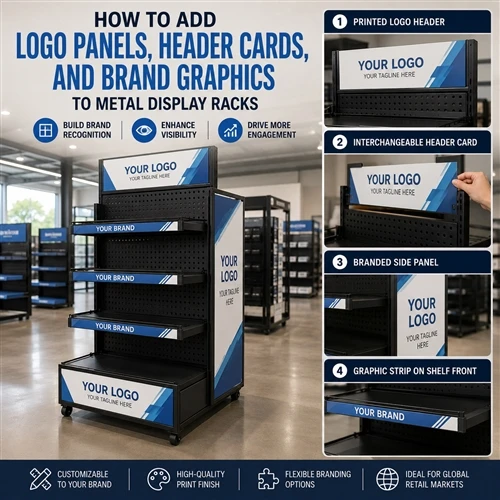
- Header card or logo panel
- Hooks, baskets, or product holders
- Wheels, feet, screws, and connectors
Each part should be designed to fit safely into the carton without rubbing, bending, or damaging the finish. The factory should also consider how the parts will be removed from the carton and assembled in the correct order.
3. Use strong connection points
The most important part of KD display rack design is the connection system. A fully welded rack can be strong because many joints are fixed at the factory. A KD rack depends on bolts, slots, brackets, hooks, screws, or other connectors after assembly.
If the connection points are weak, the rack may shake, lean, or loosen during use. This is especially important for tall racks, heavy-duty racks, pegboard displays, and racks with wheels.
Strong KD connection design may include:
- Reinforced bolt positions
- Stable slot-and-tab structures
- Thicker metal at high-stress areas
- Cross braces or back supports
- Locking brackets for shelves
- Anti-loosening screws or washers
- Clear left-right and top-bottom positioning
A good KD rack should feel stable after assembly, not temporary or loose.
4. Balance freight savings with assembly time
Some designs can be disassembled into many small parts to reduce carton size, but too many parts may make assembly slow and confusing. Buyers should balance freight savings with labor cost.
For example, if a rack saves a small amount of shipping volume but requires much more store assembly time, the total cost may not improve. For retail chains, distributors, and store rollout projects, assembly time can become a real business cost.
A practical KD design should answer these questions:
- How many parts are in one rack?
- How many screws or connectors are required?
- Can one person assemble the rack?
- How long does assembly take?
- Are the parts easy to identify?
- Can the rack be assembled without special tools?
5. Design for tool-free or simple-tool assembly when possible
Tool-free assembly can improve user experience, especially for store staff who need to assemble multiple racks quickly. This may include slot-in shelves, hook-on panels, snap-fit brackets, or pre-installed connectors.
However, tool-free assembly is not always the best choice for heavy-duty racks. For racks carrying heavy tools, tiles, hardware, or bottled products, bolts and reinforced brackets may provide better strength.
The best solution depends on product weight and store use. A professional factory can suggest whether the rack should use tool-free assembly, screw assembly, or a mixed structure.
6. Keep accessories organized and easy to identify
Small accessories can create big problems if they are not packed clearly. Missing screws, mixed hooks, unclear brackets, or unlabeled parts can delay store setup and create complaints.
For KD display racks, accessory management should be confirmed before mass production. Each rack should include the correct quantity of screws, bolts, washers, hooks, wheels, clips, and spare parts when needed.
Good accessory packing may include:
- Separate accessory bags for each rack
- Labels for screws, hooks, and brackets
- Spare screws or small parts
- Clear quantity checking before carton sealing
- Instruction sheet placed in an easy-to-find position
7. Use clear assembly instructions
A KD rack should include clear assembly instructions, especially for overseas buyers distributing racks to different stores or dealers. Good instructions reduce installation mistakes and make the product feel more professional.
Assembly instructions should include:
- Parts list
- Hardware list
- Step-by-step assembly sequence
- Simple diagrams or photos
- Tool requirements
- Important safety notes
- Final load or stability reminders
For larger projects, buyers can also request an assembly video. This is useful for distributors, store teams, or retail chains that need to install many display racks quickly.
8. Protect powder coated parts during packing
KD packing can reduce shipping volume, but it also means multiple metal parts may be placed together in one carton. Without proper protection, powder coated surfaces can scratch during transportation.
Export packing should prevent painted parts from rubbing against each other. Heavy parts should not press directly on delicate panels or logo boards. Hooks, screws, and accessories should be packed separately so they do not damage the coating.
Common protection methods include:
- Plastic bags for individual parts
- Foam sheets between painted metal parts
- Cardboard dividers
- Corner protectors
- Separate accessory bags
- Strong export cartons
- Pallet packing for heavy or large orders
9. Optimize carton size and container loading
The main purpose of KD design is often to reduce shipping volume. To achieve this, the factory should consider carton dimensions and container loading at the design stage, not after production is finished.
Small design changes may improve packing efficiency. For example, changing shelf depth slightly, using removable side frames, stacking panels more efficiently, or adjusting base structure can improve carton volume and container quantity.
Before confirming bulk production, buyers can ask the supplier to provide estimated carton size, gross weight, packing quantity, and container loading quantity. This helps evaluate the real landed cost.
10. Make sure KD design does not reduce load capacity
A KD structure should save freight, but it should not make the rack weak. Every connection point should be checked based on the real product load. Shelves, hooks, pegboard panels, bases, and brackets must remain stable after assembly.
For heavy-duty display racks, buyers should request sample assembly and load testing before mass production. The sample should be tested in the same KD structure that will be used for bulk orders.
Important test points include:
- Rack shaking after assembly
- Shelf bending under load
- Hook strength and pegboard stability
- Base stability when fully loaded
- Connector strength after repeated handling
- Whether screws loosen during use
11. Consider store rollout and distribution needs
If the racks will be distributed to many stores, KD design should support easy logistics. Each carton should be clearly labeled, and each rack should include all required parts inside one package when possible.
For retail chain projects, clear packing can reduce warehouse sorting time and store installation mistakes. Buyers may also need outer carton labels, barcode labels, part numbers, store allocation labels, or pallet labels depending on the distribution system.
These details should be confirmed before bulk packing begins.
12. Compare total cost, not only factory price
KD design may require more engineering work, connectors, screws, instruction sheets, or packing planning. This can slightly increase the factory production cost. However, it may reduce ocean freight, storage cost, and damage risk.
Overseas buyers should compare the total landed cost, including product cost, packaging, ocean freight, warehouse handling, assembly labor, damage rate, and replacement cost.
In many projects, a well-designed KD display rack can provide better total value than a fully assembled rack, even if the factory unit price is slightly higher.
13. Common KD design mistakes buyers should avoid
KD design is useful, but poor KD design can create problems. Buyers should avoid these common mistakes:
- Reducing carton size without checking rack stability.
- Using too many small parts and making assembly difficult.
- Not labeling accessories clearly.
- Using weak connection points for heavy products.
- Ignoring powder coating protection inside the carton.
- Approving mass production without sample assembly testing.
- Not confirming carton size and container loading quantity before production.
KD metal display rack design checklist
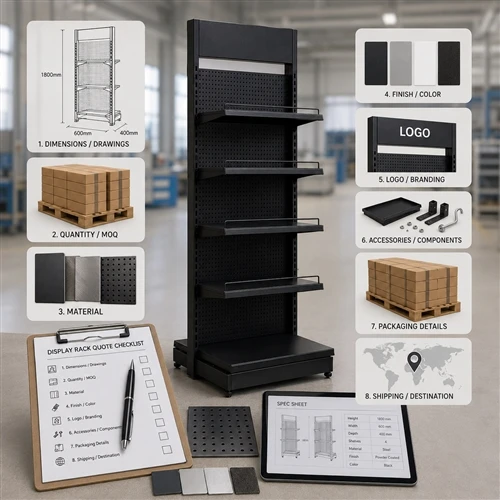
Before confirming a KD display rack order, use this checklist:
- Confirm whether the rack should be fully assembled, semi-KD, or full KD.
- Confirm the product weight and load capacity requirement.
- Check whether the KD structure remains stable after assembly.
- Confirm all connection points, screws, slots, and brackets.
- Check whether one person can assemble the rack easily.
- Confirm assembly time and tool requirements.
- Prepare clear assembly instructions or videos.
- Confirm accessory packing and spare parts.
- Confirm surface protection inside the carton.
- Check carton size, gross weight, and container loading quantity.
How Nine Roc Display helps buyers design KD display racks
Nine Roc Display helps overseas buyers design custom KD metal display racks that balance freight savings, assembly convenience, strength, appearance, and export packaging. Our engineering team can review your product weight, store layout, display method, target quantity, and shipping requirements before recommending a practical KD structure.
We can help optimize side frames, shelves, bases, pegboard panels, hooks, logo panels, connectors, packing method, carton size, and assembly instructions. The goal is to reduce ocean freight while keeping the rack stable and easy to use in retail stores.
Whether you need pegboard display stands, wire display racks, floor-standing racks, gondola shelving, slatwall display fixtures, tool racks, tile display racks, or custom POP metal displays, Nine Roc Display can help develop a KD solution for your project.
FAQ
What does KD mean in metal display racks?
KD means knock-down. It refers to a display rack that is shipped in separated parts and assembled after delivery. KD design is also called flat-pack or disassembled structure.
Can KD display racks reduce ocean freight?
Yes. KD display racks can reduce packing volume and improve container loading efficiency. This often helps lower ocean freight cost compared with fully assembled racks.
Are KD metal display racks strong enough?
Yes, if the connection points, frame structure, screws, brackets, and base are designed correctly. For heavy products, sample assembly and load testing are recommended before bulk production.
Is tool-free assembly suitable for all display racks?
Not always. Tool-free assembly is convenient for light or medium-duty racks, but heavy-duty display racks may need bolts, reinforced brackets, or stronger connection methods for safety.
What should be included in KD display rack packaging?
KD packaging should include protected metal parts, labeled accessories, screws or connectors, instruction sheets, spare parts if needed, strong export cartons, and surface protection materials.
What information should I provide for KD display rack design?
Provide product size, product weight, target rack size, loading quantity, store environment, assembly requirements, order quantity, packaging needs, and destination country or port.
Talk to the Nine Roc Display Engineering Team
WhatsApp / Phone: +86 13688842636
Email: display@nineroc.com
See our custom solutions: www.ninerocdisplay.com

Your Direct Source Factory for Custom Metal Display Racks
Stop overpaying middlemen. Partner directly with Nine Roc Display for your retail fixtures. Whether you need custom pegboards, heavy-duty gondola shelving, or wire racks, our engineering team providesFREE 3D designsand fast prototyping. Send us your ideas today, and let's bring your retail vision to life with premium quality and factory-direct pricing.